Strengthening a Historic Link: Bishop Mike Harrison Reflects on His Visit to Melanesia
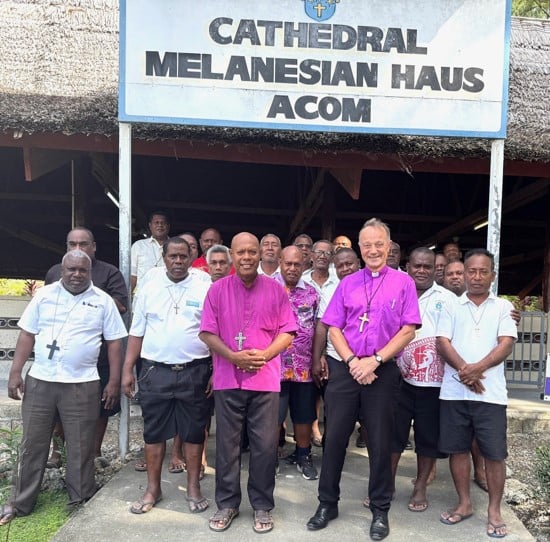
In August Bishop Mike Harrison and his wife Rachel, travelled to the Province of Melanesia, visiting churches, schools, religious communities and development projects. The visit also celebrated the long and historic relationship between the Diocese of Exeter and the Melanesian Church, a connection that stretches back to the nineteenth century through Bishop John Coleridge Patteson, the first Bishop of Melanesia. Bishop Patteson was raised and ordained in Devon and is commemorated in churches across the diocese. At MMUK’s 2026 Festival Day, Bishop Mike shared a rich and deeply personal reflection on the people, faith, challenges and hospitality he encountered during his visit. We are delighted to publish his address in full below.
I was given many different titles at different points, your grace, my Lord, Daddy Bishop, Archbishop, Archbishop of Exeter and perhaps most enjoyable of all Archbishop of England….and my wife Rachel enjoyed a variety of labels too, whether mama bp, “your lovely wife” or Mrs Bishop. But this was a way of showing respect for the dignity of the offices that were held by various people and it was touching to see the ways in which people accorded one another respect and honour by so doing.
This is not a small thing I think. The much-neglected Dutch theologian Adrian Van Kaam writes of foundational dispositions which enable engagement with the divine and effect character formation, spiritual dispositions enabling love which include being present to others in caring ways that express reverence and respect.
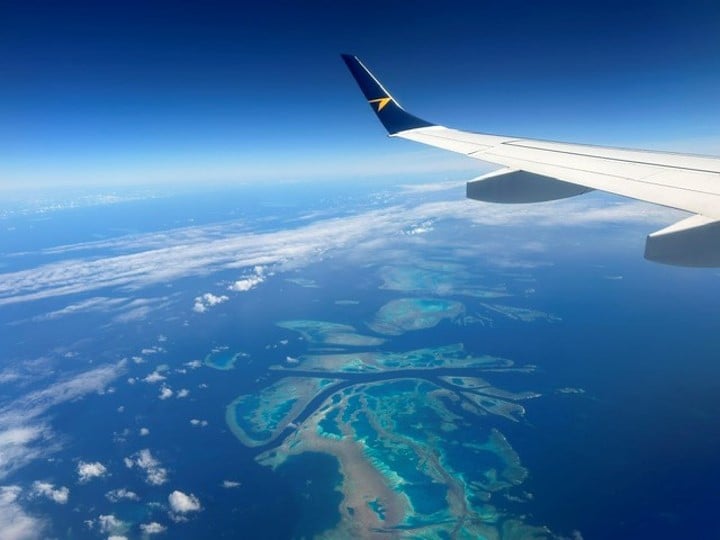
Honiara is a long way from Exeter. In fact we left on Sunday evening from Heathrow and arrived on Wednesday lunchtime in Honiara. The distances are not lost our hosts, and more than once it was mentioned that “only the brave and the committed” come to Solomon Islands. There is a depth of gratitude for travelling and considerably more gratitude for the original Christian missionaries whose journeys were considerably more hazardous and extended. The wall of heat as we left the airport reminded us we were no longer in Kansas; the humidity through the trip was around 80% – making for a rapid turnover of purple shirts.
Our greeting on arrival at Chester Rest House was exuberant and lively – with garlands, a musical band of pipers and drummers together with dancers and the assistant bishop of Central Melanesia +Othniel giving us a warm welcome. A quick change and we were off to the diocesan offices for an initial briefing with the key staff of the Anglican Church of Melanesia just down the hill.
Next morning we visited the provincial Cathedral of St Barnabas, meeting Cathedral staff and then leading a bible study morning and afternoon – ie about 4 hours.
The Bible Study was for the clergy of the diocese of Central Melanesia and I chose the Sermon on the Mount. The innate shyness and respectfulness of Melanesians and the fact it was clergy listening to a Bishop meant that when it came to inviting questions there was a time of extended silence. Asking questions can be regarded as challenging authority, as can looking someone directly in the eye, so my attempts to catch someone’s gaze were somewhat futile, at least initially. Add to this the fact that in this culture looking down or away can be a mechanism for maintaining proper boundaries and showing respect as well as of peaceful intentions and cooperation, plus Melanesians placing a high value on humility and avoiding bringing attention to oneself, and you can see I was not about to be battered by questions. Anyway, after a while a brave soul asked a question and the engagement slowly increased.
One interesting discussion was around Jesus’ teaching of not letting the left hand know what the right hand is doing. This was in tension with how in Melanesia, there is a practice of remembering and maintaining social debts, exchanges, and responsibilities within a community. In some ways it is about reciprocity: when someone gives you something—such as food, pigs, money, labour, land, or ceremonial valuables—you are expected to respond appropriately at a later time. People may carefully remember who gave what to whom, on what occasion, and what is owed in return. These exchanges create an ongoing relationship of obligation, rather than being treated as a one-off transaction. Rather remembering and fulfilling obligations helps maintain relationships, reputation, alliances, and social cohesion. How does that fit with Jesus’ stress on secrecy?
We reflected that there was a tension in Jesus teaching because while on the one hand one shouldn’t be dwelling on one’s virtuous actions, equally the same sermon suggested we were called to be like a city set on a hill and a lamp on a lampstand, glorifying our God in heaven by our good works. Bonhoeffer for example says this is not a contradiction; he says discipleship is about allowing our gaze to be taken up more and more by the One whom we are following – and what then becomes hidden or secret is the disciple’s own sense of their righteousness. Bonhoeffer writes of self-forgetfulness – a following of Jesus that so dominates that our self-preoccupation is eclipsed as our horizon fills with Christ. Thomas Merton says you notice this in the saints, who he says aren’t marked by being admirable so much as their capacity to admire, to look outwards in admiration, of others, of Christ in others. And of course other-centred practices of gratitude, generosity, wonder, gazing, attending to the beautiful all aid this orientation.
Gradually the questions got sharper and sharper – such as “Does God hate the rich?” and “How can we be generous to asylum seekers without endangering the way of life of one’s own country?” – indeed as sharp a set of questions as one might find anywhere.
So you can see, we got into it. That day Rachel met with MU leaders and in the evening Archbishop Leonard and his wife Dora provided a welcome dinner for us.
Next day, Friday we visited Bishop Norman Palmer Anglican primary and secondary school, with links with schools in Devon, Feniton School and Tipton St John School. We re-dedicated a prayer space in memory of Bishop Norman Palmer who was the first Melanesian to lead the Province of Melanesia as Archbishop. Then on to the Red Beach Observatory site, one of a number of environmental observatories which measured coastal erosion – 4 metres in 6 years recently. The vulnerability of the islands is clear to see – many dwellings are right on the beach, the roads are close to the sea and there is little levitation between the road and the sea. Unpredictable temperatures, heavy rainfalls, intense weather events, all further contribute to troubling signs. On from there we visited St Nicholas School Farm, an agricultural training/education farm associated with the Anglican Church of Melanesia. The farm is used for food-security demonstrations and agricultural education. It serves more than 150 agriculture students and it has model gardens and a poultry enclosure. The farm is also used by ACoM for community training in food security near Honiara.
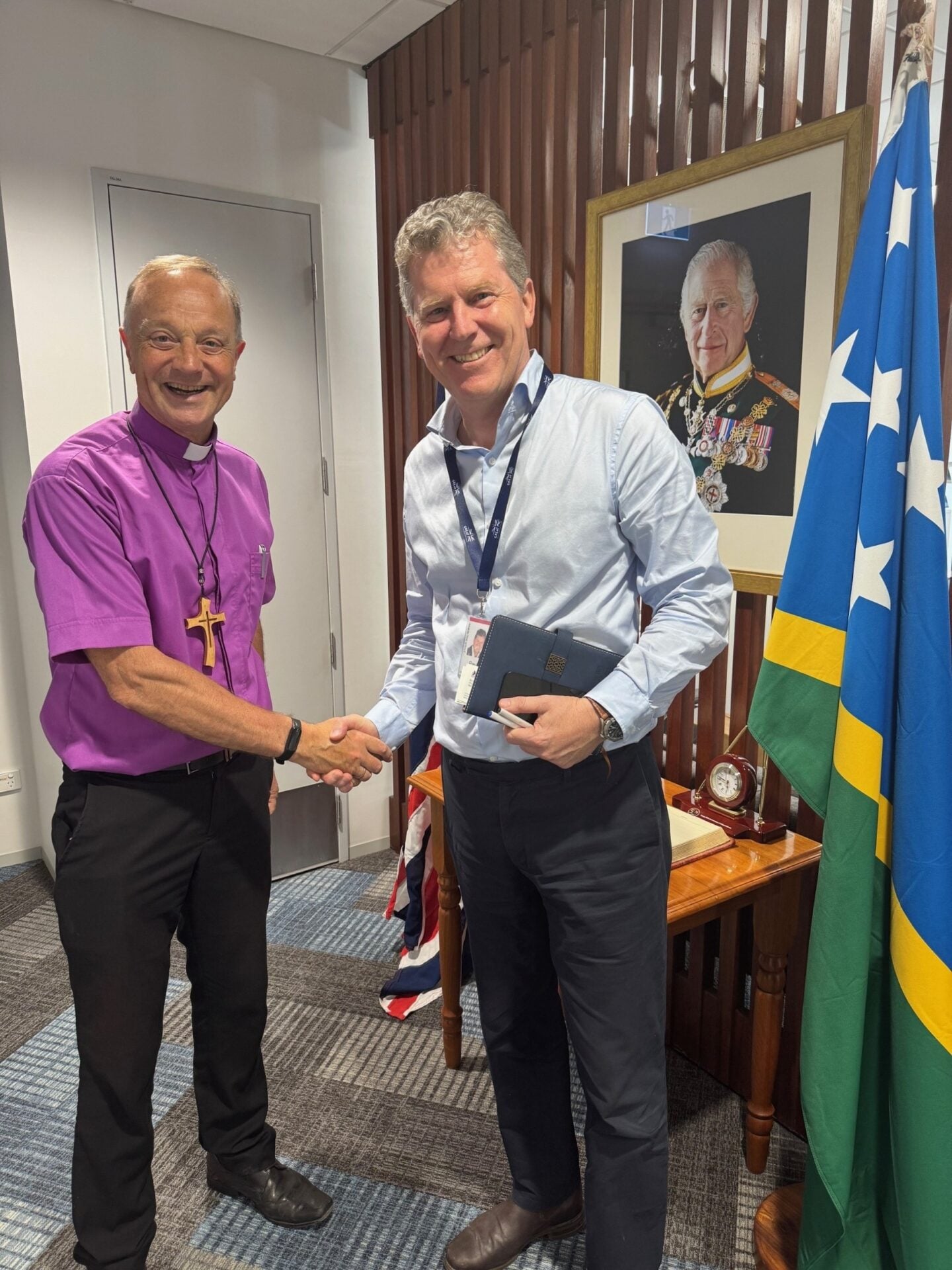
Back to base and then on to the British High Commissioner Paul Turner who provided a wide-angled view of the situation in the Solomon Islands. Matthew Wale was voted in as the new Prime Minister in May 2026. Wale is resetting relationships positively with Australia, the USA, New Zealand and more slowly with China, all of whom regard these islands as geopolitically highly strategically significant, and Wale is addressing some of the endemic corruption, sacking some in the forestry commission and challenging elite capture practices. Wale only has 20 months till the next election but has made as his flagship policy free education for all from primary to tertiary levels. This seems unlikely to say the least – both in terms of capacity building (numbers of teachers) and in terms of capital projects (schools &university buildings etc).
There are opportunities of course. Tourism doesn’t have an enabling infrastructure but there is WW2 tourism to be developed, world-class diving and snorkelling with shipwrecks galore, white sands and glorious beaches. Utilising the push-me pull you between China and Australia and New Zealand can work in the islands favour – at present 70% of the Australian overseas development budget comes to the islands, all of which is reactive to what the Chinese are doing according to the High Commissioner. Developing extractive industries in gold and nickel in ways which prevent the profiteering of just a few (as with logging) will be important, as will projects such as the Teena river hydro-project providing cheaper power to Honiara in a geography with the highest energy costs in the world. The challenges are considerable for the Prime Minister – while the official unemployment rate is 1.43% those in f/t formal employment are fewer than 30%. 60-70% of the population is under 30 and youth employment is a massive challenge. Add to this increasingly expensive travel costs limiting tourism to such a distant set of islands, a lack of infrastructure such as roads, sanitation and the internet, limited healthcare and educational facilities and the scale of the task becomes clear. Having said this, there is a danger of measuring the situation by narrow Western criteria of socio-economic success and the Islanders modus vivendi does not suggest a crisis – they are among the warmest, most good humoured and friendly people one could wish to meet.
Saturday morning saw us celebrating Mary Sumner day – the founder of the Mother’s Union and I preached to a packed church at All Saints Honiara with +Othniel Gamutu presiding, a generous buffet to follow with dances offered from a variety of MU branches from around the diocese. We then travelled in the afternoon to Tabalia on some pretty bumpy roads for a couple of hours and stayed overnight with the Melanesian Brothers (about which more later) in order to get to Selwyn College school early on Sunday morning for the Feast of the Transfiguration. We arrived on time on the Sunday morning and the whole school of nearly 800 pupils were waiting in chapel together with 35-40 teachers. +Stephen Koete presided and I preached on the theme of transfiguration.
The liturgy, as on most occasions, was familiar in structure, the tradition being gently Anglo-Catholic with a keen emphasis on both Word and Sacrament.
Again following a tasty and plentiful buffet lunch there were dances and music offered by a variety of groups, organised not by year group but by island in traditional and colourful dress.
We then travelled back to Honiara, pothole by pothole, and slept well.
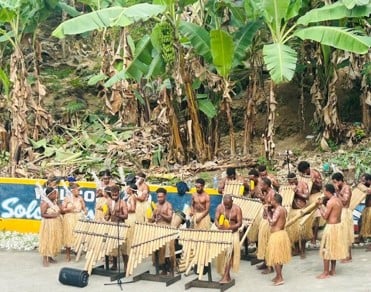
The following day, Monday 10th August we visited the HQ and Cathedral of the diocese of Guadalcanal and were hosted by Bp Benedict Loe, who showed me his diocesan boat, which I confess I coveted. Moments after leaving the car we were assailed by six spear waving natives threatening us with all manner of unpleasantries before the leader of the group called a halt to their hostile proceedings and greeted us as the CW of the Cathedral. The gesture reminded us of the reception the 1st missionaries might have experienced. Next we were led by 30 or so MU members serenading us with some women in native attire to the Cathedral of the Good Shepherd. It has to rank as the best welcome to a bible study I’ve ever had. Then while mama Bishop Rachel met with members of the MU, I conducted a bible study for clergy of the diocese.
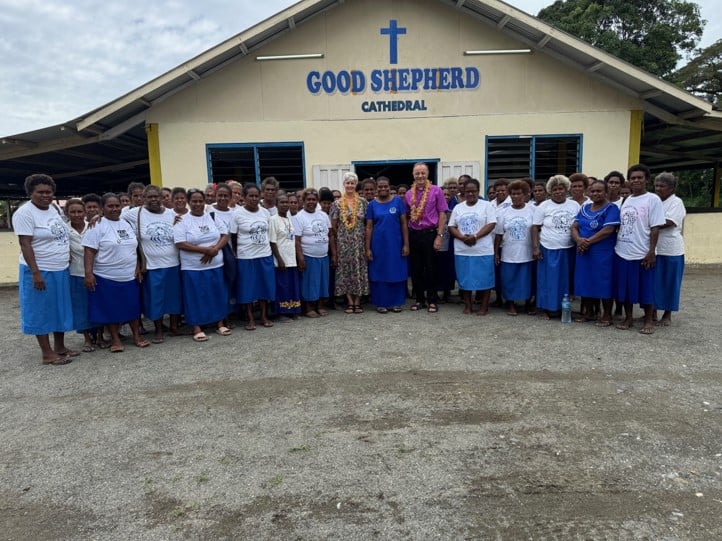
Another delicious lunch of chicken, fish, rice and fruit and convivial conversation with +Benedict and his wife Charity, and we were off to visit the proposed site of the John Coleridge Patteson University. At present there is a single, albeit impressive building but there’s lots to do while projected completion dates of 2030 were mentioned it’s not clear whether this is concrete deadline or projected aspiration. Either way it’s good to see the Province investing in a potential Christian university in this way.
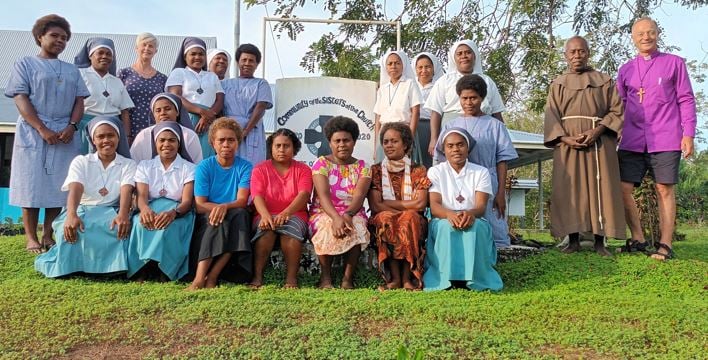
On from there we arrived at the convent of the Community of the Sisters of the Church. This is an Anglican religious community that has been working in the Solomon Islands since 1970. The sisters came from the wider Anglican community and established their work in the Province of Melanesia. The site is known as TNK Tetete ni Kolivuti, hill of prayer, located on the Guadalcanal Plains, east of Honiara. It is a centre for the sisters’ religious life, ministry, retreats and service to surrounding communities.
The CSC’s ministries include: Prayer and worship, Christian formation and teaching , Retreats and spiritual formation, service to vulnerable people and in particular running the Christian Care Centre, which provides shelter and support for women and children affected by domestic violence.
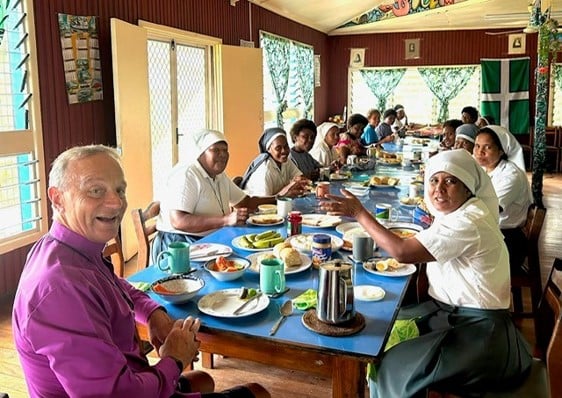
The redoubtable leader and provincial sister is Rev. Sr. Veronica Vasethe who kindly drove us to the Care Centre. It receives government funding and while the government is promoting awareness of domestic abuse, the stats remain disturbing across the islands and there is slow progress. I asked the sisters what they liked most about this work and their work more widely and their first and immediate answer was “praying” – the worst things being tediously long waits when accompanying people to hospital or at court, having no sleep with children being sick and very angry husbands trying to visit. Sr Veronica was candid that not all the nuns were cut out for this kind of work – it could be quite intense and draining and it needed a certain set of qualities.
We loved our time at CSC – the early morning quiet meditation as the sun rose, the morning Eucharists, the atmosphere of peace and care, the entertainment from the sisters, the generous hospitality – though we drew a line at fish heads – and. Sr Veronica is a force of nature – the only ordained woman in the Province – something of an anomaly in that she was ordained in England and returned to the Islands where her ordination was recognised. Indeed meeting with the bishops of the Islands just after the CSC the key matter they wanted to discuss was women’s ordination. They asked how many ordained women we had in Exeter diocese, what difference they had made, what arguments I would make for women’s ordination and so on. They were all in favour as far as I could tell, and all frustrated by a Provincial Synod that had recently voted it down “on an entirely cultural basis” as they put it. (Though as an aside and intriguingly I was told that six of the islands are patriarchal but three are matriarchal in culture – hmm). I enquired how they would respond to a female ABC visiting – Abp Leonard said he had been very impressed with ++Sarah at the ACC in Belfast, her humility and quiet effectiveness, but didn’t quite give me an answer to whether he would be extending an invitation for ++Sarah to visit the Province.
After meeting with the Bishops – 8 out of 11, as some were having IT issues connecting from the more distant islands – we set off for Tabalia again and this time to be hosted for a few days by the Melanesian Brotherhood. We worshipped morning and evening with the Brothers, of whom across the islands there are about 400, with 160 or so novices. The novices spend three years in training and they are assessed on the criteria of prayer, study and work. They are then admitted (or not) as brothers and these are not life-vows but temporary vows taken for as long as they wish to be part of the brotherhood as brothers. The novices have Friday evening off and Sunday after the Eucharist and that’s it.
We visited the graves of the seven martyrs who were killed in 2003 during a conflagration in 2003 as they worked for peace – events that are still vivid in the memories of the Islanders and the Brothers and which of course are commemorated each year on April 24th in the CofE lectionary.
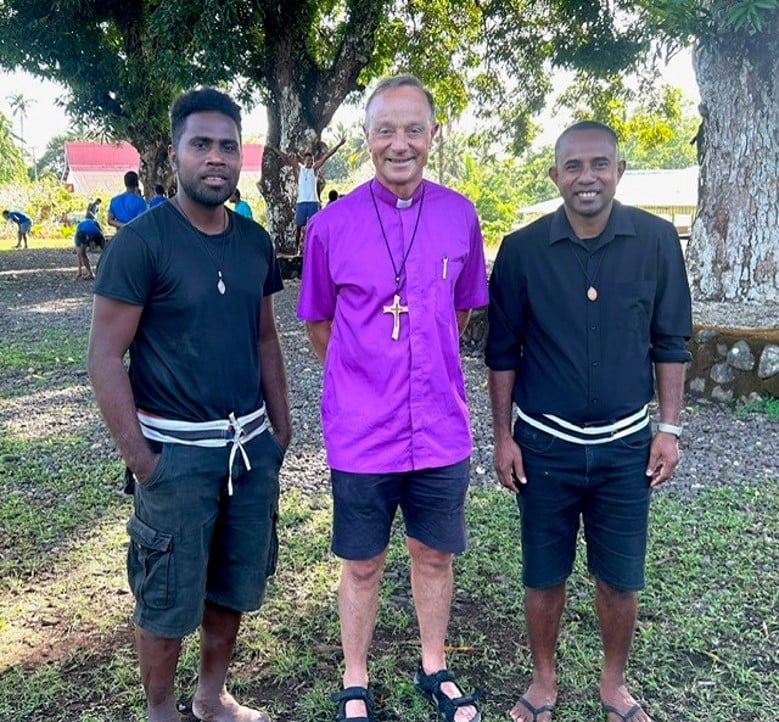
The worship was somewhat different to Buckfast Abbey in Devon where I had been on retreat two weeks before travelling to Melanesia. There the Psalms are said as quietly as possible, whereas I’ve never heard them said as loudly as the brothers and novices declare them. As ++Rowan said yesterday it bespeaks a certain boldness, indeed it felt as if the novices in particular were shouting encouragement to one another through the loud recital of the psalms. Not that it was always the same pitch or volume, and when moments of softness and quieter volume were voiced it was all the more moving for that. The liturgy was clearly influenced by the offices of the Anglican Church more widely and the BCP in particular, and there was a reverence for the reserved sacrament – as with most of the churches we visited. There was also an unusual mixture of bells – mainly prior to the services, reminiscent to my mind of a Soto Zen Temple. The verse that came most frequently to mind as I participated echoed Ps 28.7 “My heart is full of praise to my Lord, and my spirit is full of joy in God, my Saviour”. It was different, and to riff off Stanley Hauerwas, maybe liturgy does its work just to the extent it makes the familiar strange.
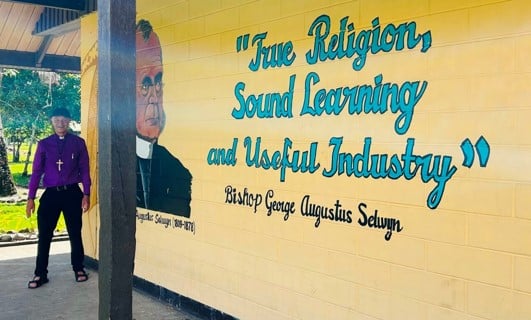
Thursday 13th August saw us visiting Selwyn College to meet with the Principal, staff and students – and I discussed with the Principal the forthcoming 200th anniversary of +Selwyn’s death and how that might be marked in 2028. Conversations are ongoing with the dioceses of Auckland, Lichfield, Exeter and Melanesia at present, with interest from Selwyn school and of course Selwyn College, Cambridge University. In the afternoon we visited La Verna Franciscan Friary and I was glad to be reminded that this year is the 800th anniversary of St Francis death on 3rd October. The friars had already built an amphitheatre in the forest which will be the centrepiece for a theatrical production of the life of St Francis. From there we went on to another religious community, the Anglican Community of the Sisters of Melanesia, a much smaller order than the CSC and less-well resourced with 30 sisters and about 26 novices. Founded in 1980 the community was established with a vision similar to the Melanesian Brotherhood: to have a locally founded religious community dedicated to evangelism, mission, prayer, education and service.
They asked that we bear in mind their need for bibles for those they worked with – so I mention that now.
Back to Tabalia for worship and supper and so to bed. On Friday 14th August we visited Bishop Patteson Theological College which is literally a stone’s throw from the Brotherhood’s premises and there we were warmly greeted by the Principal, Faculty and Students. I was invited to provide a guest lecture (as a number of you here today have previously been so invited).
After this we returned to Honiara and were invited to dinner at the High Commissioners. Also attending were the Roman Catholic Archbishop of Melanesia, Chris Cardone and Sir Bruce and Keithee Saunders, long term residents and effectively patriarch and matriarch of the international community in Solomon Islands.
++Chris has been a priest and bishop across the islands for 40 years and actually been diocesan bishop of each of the dioceses making up his jurisdiction, so he knows his Archdiocese. It was interesting getting his take on Christianity across the islands. The islands are 98% Christian, but there has been an influx of Pentecostal and Charismatic churches in recent history which, added to Mormons and others, makes for a more diverse mix than in times heretofore. Archbishop Chris spoke about Blessed Peter To Rot (1912–1945) — The most significant indigenous Melanesian Catholic martyr. A Tolai layman, husband, father and catechist from Rakunai, New Britain, he continued teaching the Catholic faith during the Japanese occupation of Papua New Guinea in World War II. He particularly defended Christian marriage against the reintroduction of polygamy. He was arrested and killed in 1945. The Archbishop says people still remember how the priests and the nuns and the monks stayed with the people when the Japanese invaded and lived with them in the hills and the gruelling conditions while – as he put it, many of the Protestant missionaries left with their families for safer territory. Of course it wasn’t quite such a tidy separation but I wasn’t going to spoil a lovely atmosphere at dinner.
The bigger point is that whether it is Blessed Peter de Rot or Bishop John Coleridge Patteson giving their lives as they endeavour to spread the good news, the fecundity of martyrdom has a profound affect on the Church and context in which it happens. Tertullian’s words are often quoted because they resonate with ecclesial experience, that the blood of the martyrs is the seed of the Church, and the early Church had plenty of martyrs because it pulsated with hope, resurrection hope, and acted in line with that hope. The honouring of these martyrs in the Solomon Islands is not ammunition to attack decolonisation narratives; rather it is about the recognition of that authentic witness to Christian faith that speaks across generations, across ethnic, cultural and geographic divides and which gives confidence, resolve and inspiration to Christians wherever that blood is shed.
Our final day before flying out of Honiara was an invitation to preach at the provincial Cathedral of St Barnabas Honiara which has a shrine containing the burial mat used for Bishop Patteson as well as some of his books, and in the evening a final dinner with the Melanesian Church senior leadership team. That was an occasion where, after nearly two weeks, the shyness and reticence had given way to cheerful, relaxed and jovial conversation and there was much laughter and enjoyment around the table, as well as interesting insights into how for instance dating happened in such a context.
We flew out the next day, blessed, tanned and a case full of garlands.
Rt Revd Mike Harrison – Bishop of Exeter