
An Unexpected Adventure
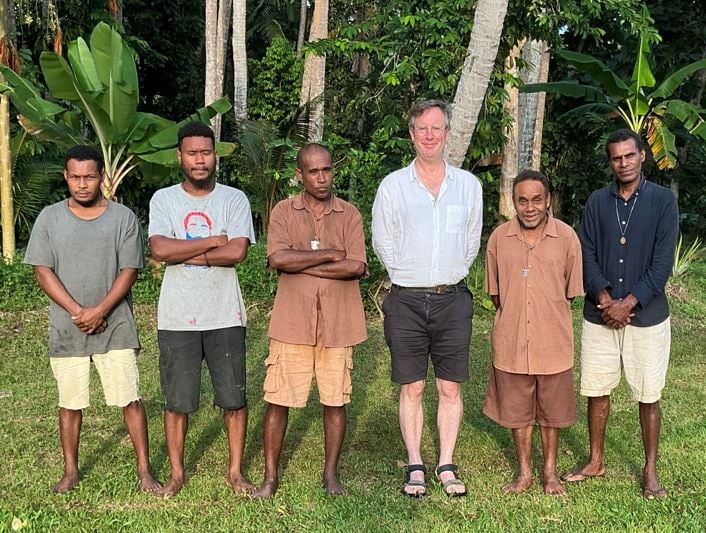
When Revd Canon Jonathan Lawson from Newcastle Diocese, travelled to Solomon Islands on sabbatical, he discovered far more than he expected. From leading a retreat for Melanesian Bishops to visiting religious communities across the islands, he encountered deep faith, generous hospitality and lasting friendships.
Read Jonathan’s reflections on a remarkable journey through the Anglican Church of Melanesia and the people of the “Happy Isles”.
‘Why not visit the Melanesian Brotherhood?’ It seemed a slightly left field suggestion by our Bishop, when I asked her if I might be granted a sabbatical, at our meeting in 2024, but nonetheless one worth pondering. Odd too, because a few weeks before I had heard that Archbishop Leonard of Melanesia was taking a retreat at St. Beuno’s, a retreat centre for Ignatian Spirituality where I am a guest director. Then I got in touch with Bishop Sam Corley, whom I know through vocation work, to talk to him about vocations in the Church of England. He apologised that he had been slow in getting back to me, as he had just come back from the Solomon Islands, which is a link Diocese with Chester Diocese where he is a suffragan bishop. ‘How strange’, I said, when we finally spoke, ‘my Bishop has suggested that I have a sabbatical there’. ‘You have to go!’, said Bishop Sam, in that authoritative way that he does, ‘and I can help make that happen’. He wrote to the Archbishop, who immediately invited me to lead a retreat in June 2026 for him and his fellow bishops in Melanesia. It then began to look like something might indeed happen for my sabbatical in the South Pacific.
Subsequently, I had a really useful meeting with Father Richard Carter, who had been Chaplain to the Melanesian Brotherhood, and then with him and Katie Drew from the Melanesian Mission UK, and before I knew it, a timetable had been prepared for a month’s visit to the Solomon Islands.
The Solomon Islands are a former British Protectorate, and a member of the Commonwealth, consisting of nine hundred islands, which span an area east of Papua New Guinea. Safe to say they are not a major tourist destination and not the easiest place to get to, although there are regular flights from Brisbane in Australia to Honiara, the capital city, which take about two and a half hours. I travelled via Perth in Australia, where my youngest sister and her family live, flying across to Brisbane and staying the night there before flying to Honiara, where I was met by Father Nelson and one of the Melanesian brothers who drove me into the capital. It is a very different place from Australia, let alone Europe, and I quickly got a sense that health and safety was an alien concept in the Solomons, with people piled on to the back of trucks as they travelled along the same road as us from the airport into the centre of town.
For the first few days I stayed in the Chester Rest House, run by the Melanesian Brothers, where I had my own room, with a bed, small kitchen and shower and toilet. It also had air conditioning, the only place that had it for my whole stay on the Islands. The heat there is fairly oppressive, being both hot and very humid (often around 90% humidity). As a priest in Melanesia, you don’t wear a dog collar, but a white shirt with black shorts or trousers, and a cross around your neck. Generally, people in Melanesia don’t wear shoes indoors and especially not in church, where everyone is barefoot. Often a church or chapel has coral on the ground outside, to remind you as you walk barefoot on it that the way of faith is not always easy or comfortable.
The Solomon Islands were converted to Christianity by missionaries, and 90% of the population are now Christian with 40% Anglican. There are four religious orders: The Franciscans, The Sisters of the Church, The Sisters of Melanesia and the Melanesian Brotherhood. All are very vibrant with a large number of novices as well as sisters and brothers. The Melanesian Brotherhood is the largest religious order in the Anglican Communion and its base is in Tabalia, which was the first place I stayed outside of the capital Honiara. The road to Tabalia is memorable. In fact, after Honiara, it at times cannot really be described as a road, but more as a track, with the most extraordinary craters and potholes which the driver has to either avoid or negotiate. It makes for an exciting journey.
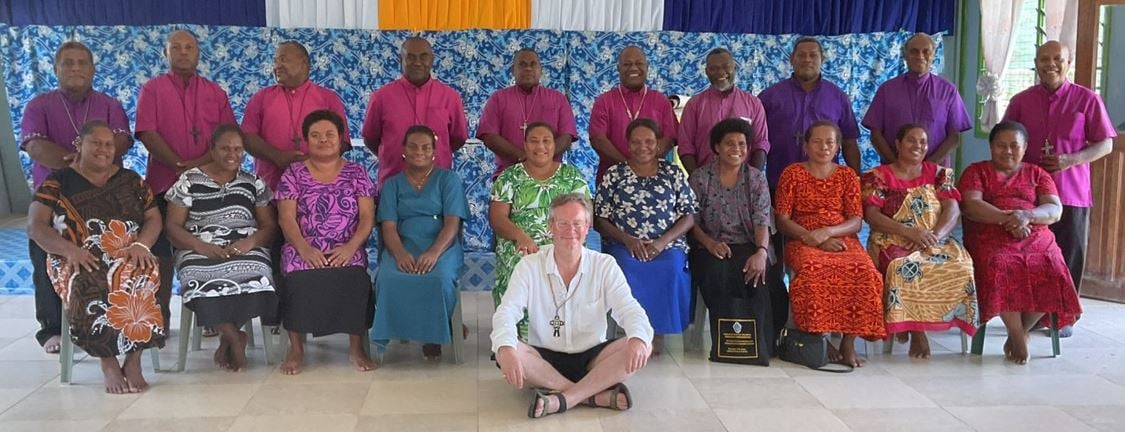
In the Anglican Church, Ini Kopuria, the founder of the Melanesian Brotherhood, is commemorated on the 6th June, the day of his death in 1945. In Melanesia there are big celebrations on that day where he is buried in Maravovo, his home village. There is a Sung Eucharist at his burial place near the beach at sunrise, at which Bishop Othniel presided and at which I was invited to preach. There was then a day of celebrations, with breakfast, speeches, lunch and dancing. Many, many people were there including the deputy Prime Minster, and people make pilgrimage (mainly on foot) to Maravovo for that day. Whilst I was staying at Tabalia, I gave a talk to the priests at the nearby Theological College on Ignatian Spirituality and also to the novices and brothers at Tabalia. I then went back to Honiara to take part in the ordination of deacons at the Cathedral, St. Barnabas’ on St. Barnabas Day (11th June) which was followed by a great feast and more speeches, singing and dancing. After that, I travelled to Tete Ni Kolivuti (TNK), the headquarters of the Sisters of the Church in Melanesia with Revd Sr Veronica, the only woman priest in the Solomon Islands, who is head of the community as well as chaplain. TNK is the other side of the airport from Tabalia, and nestled at the foot of the hills. It was here that Archbishop Leonard, his fellow bishops and their spouses came for the retreat I was to lead over a couple of days.
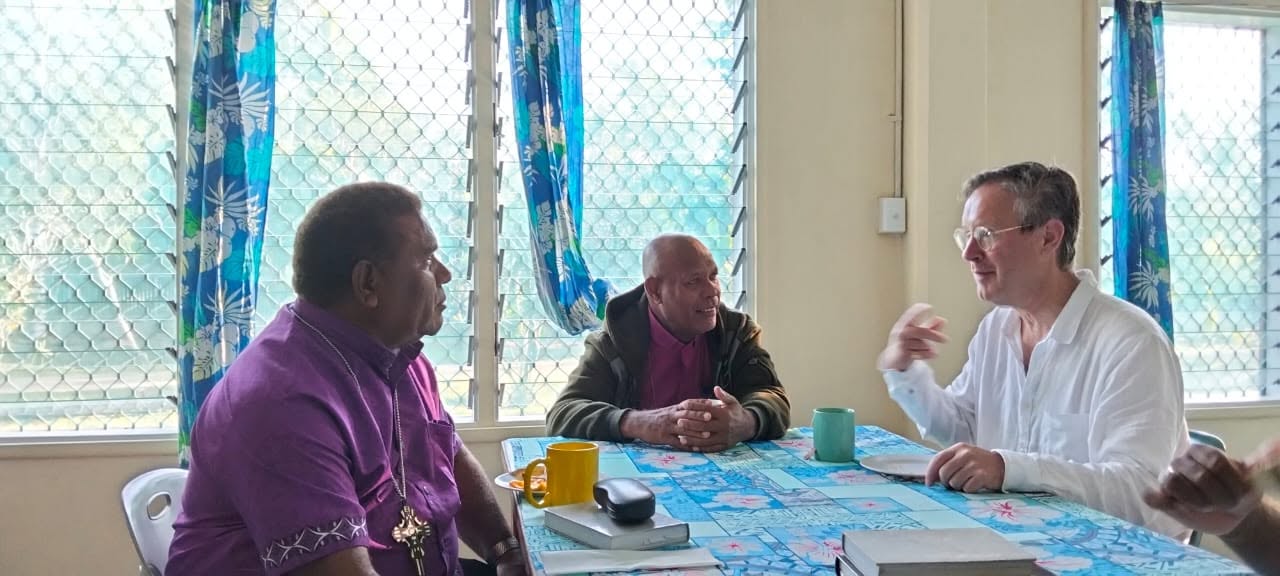
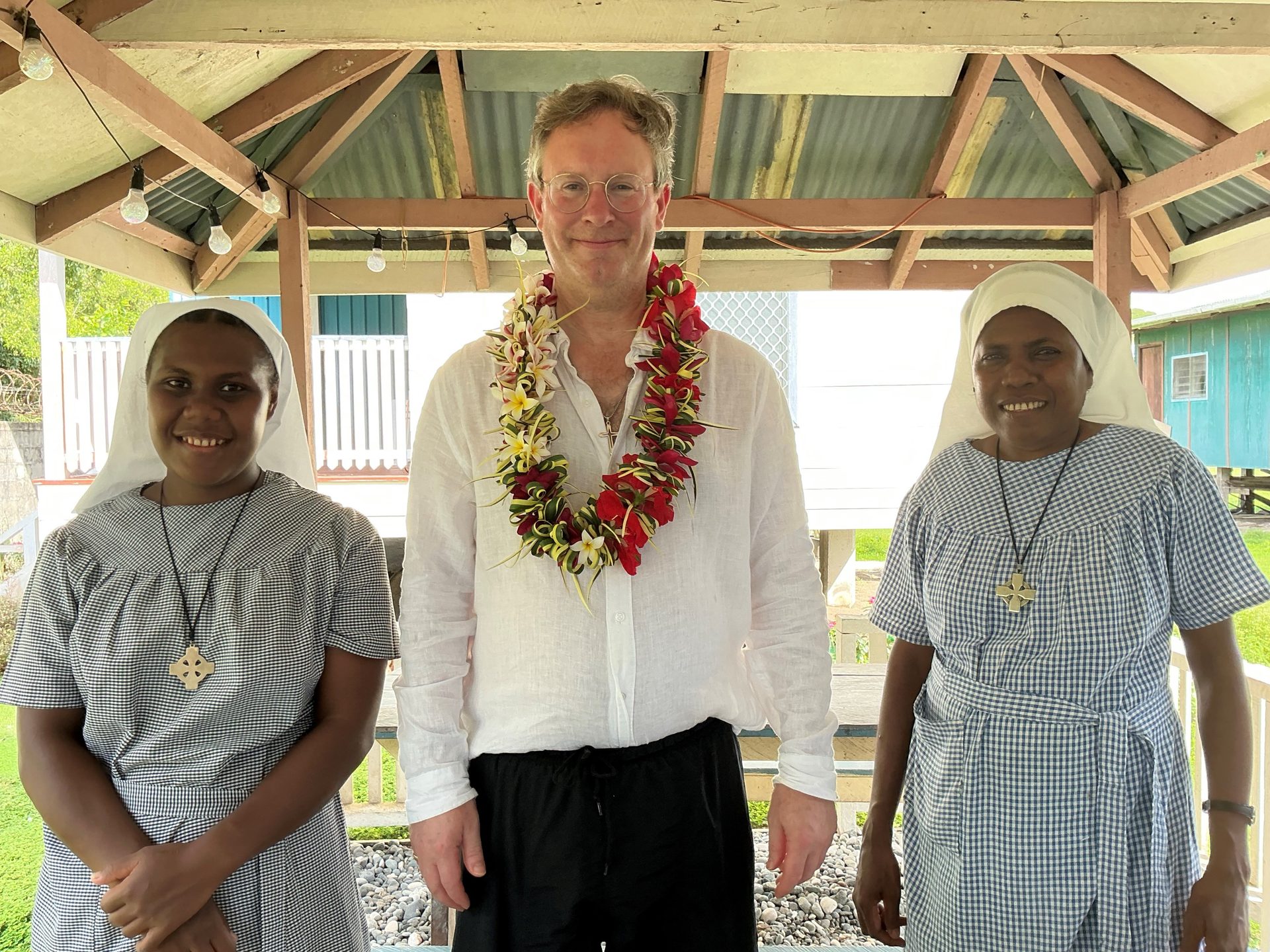
After the retreat, and two weeks into my visit, I flew to Makira Island (an hour long flight), to visit the religious communities there, including a project called St. Gabriel’s, run also by the Sisters of the Church. On Makira I stayed with the Franciscans at their house in Kira Kira, the capital of Makira (population: 2,107). I believe I had the only bed and electric fan in the house! I visited not only St. Gabriel’s, but also the Fox Melanesian Brothers ‘ House on the Island, as well as St. Stephen’s Secondary School and a rural Training College at Pamua. I thought it was only in films that people were greeted with garlands of flowers and singing, but that is not so. Everywhere I went there were flowers, singing and food, and more often than not, coconuts with fresh coconut water and chicken or tuna and rice. Whilst I was on the Island I also met with the Mothers’ Union and the clergy and religious of the Island who wanted to know more about the Ignatian ways of praying.
I was due to be in Makira for three days, but my flight was cancelled and so I ended up staying a week, taking me into my fourth and final week on the Islands. Flying back to Honiara, I then stayed back at Chester Rest House and enjoyed the novelty of a shower after a week without one. I also had the company of Bishop Sam who had just arrived for a visit along with two of his clergy from Chester Diocese: Revd Kate, who was born in Melanesia, and another Father Jonathan, which made for some confusion. With my own schedule now out of kilter, I joined them to a visit to St. Nicholas’ School and their nearby farm, followed by a trip to a beach, where tide levels are monitored to get a sense of rising sea levels. The Solomon Islands are heavily threatened by global warming.
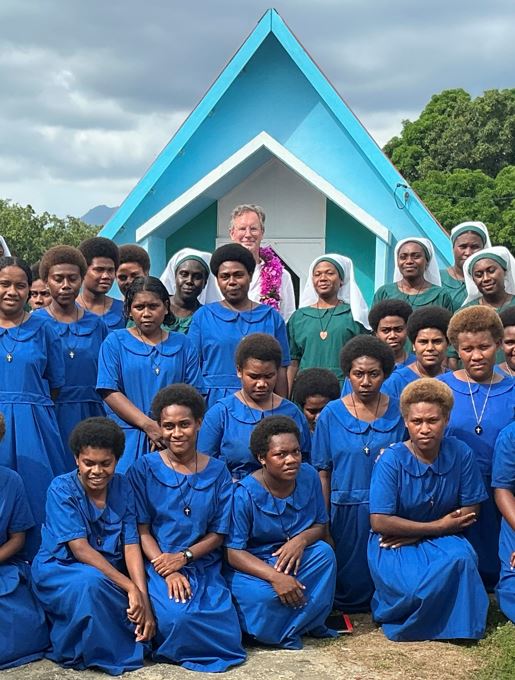
My final trip was to visit the Sisters of Melanesia and the main Franciscan House on Guadalcanal, which I did as a day visit. Again, I was welcomed with flowers, singing and food in abundance. Back in Honiara, I worshipped that Sunday at the local church, All Saints, which has a Sung Eucharist at 6.00am and 8.00am, because they cannot fit everyone into the church for one service. In the evening, the four of us went out for fish and chips – tuna in batter, which was amazing! In Makira you could buy a whole tuna at the quayside for $20 Solomon dollars, or £2.
I was escorted back to the airport by two of the Melanesia brothers, brothers Clayton and Max, and my fellow British clergy. Being British, I arrived three hours before the flight, to find I was the only person in the departure lounge for the next two hours. But it was air conditioned! I flew back to Brisbane and then back to Perth, where I spent a week before flying home.
I have so many memories of my time in the Solomons that cannot be fully captured in here. But here is one quote that has particularly stayed with me. Brother Charles SSF, the guardian of the Franciscan House where I stayed in Kira Kira said to me one day: ‘You are now part of my story, and I am part of your story’. And that is true too of the people of Melanesia, whom I hold so closely in my heart, who are now part of my story and I, theirs. It is no wonder they are called: ‘The happy isles.’
Inspired by Jonathan’s story? A visit to Melanesia offers a unique opportunity to deepen your faith, build relationships with Anglican communities across the Pacific, and experience the life of the Church in a very different context. MMUK is keen to encourage both clergy and lay people to make pilgrimages to Melanesia and can offer practical advice, support and, in some cases, grants to help make a visit possible. If you are interested in learning more, please contact the charity. We would be delighted to discuss how a journey to Melanesia could become part of your own story.