
A Powerful Witness to Reconciliation
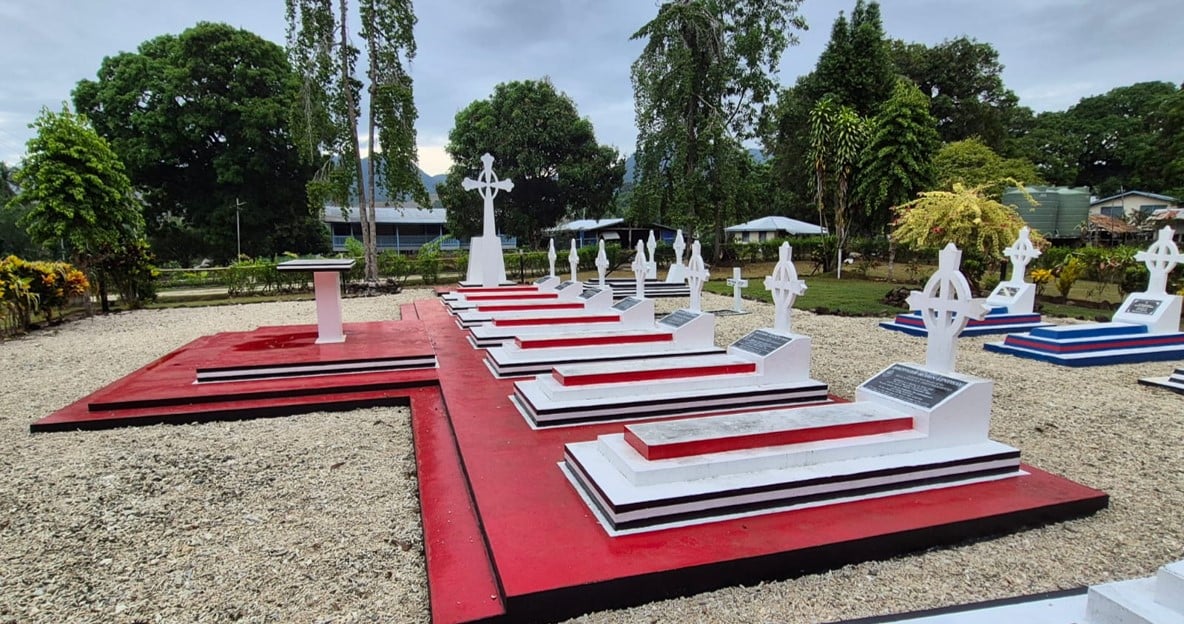
At MMUK’s Festival Day Eucharist in Exeter on 19 September 2026, Bishop Sam Corley spoke movingly about a remarkable act of reconciliation that took place at the headquarters of the Melanesian Brotherhood at Tabalia, Solomon Islands, in July 2026. During Bishop Sam’s sermon, he reflected on a gathering that brought together members of the Brotherhood and relatives of Harold Keke, the former Guadalcanal militant leader responsible for the 2003 deaths of seven Melanesian Brothers following the ethnic tensions.
More than two decades after one of the darkest chapters in the history of the Anglican Church of Melanesia, members of Keke’s family came to offer an apology and seek reconciliation. Many had lived for years fearing that they continued to bear the consequences of events over which they had no control. What followed was a powerful witness to the Gospel: an affirmation that forgiveness is stronger than bitterness, and that reconciliation remains possible even after profound loss and suffering.
The address below was delivered by Fr Jacob Chida on behalf of the Melanesian Brotherhood. It honours the memory of the seven Brothers who lost their lives while seeking peace, acknowledges the enduring pain carried by their families and the Church, and bears witness to the Brotherhood’s longstanding commitment to forgiveness rather than revenge. As we continue to pray for peace and healing in Solomon Islands, these words offer a profound testimony to Christian reconciliation, grace and hope.
The text below is reproduced with permission from the Melanesian Brotherhood.
On behalf of the Head Brother, Junior Thomas Ini, Assistant Head Brother, Reynold Wabour, the Regional Head Brothers of the three Regions, Section Elder Brothers, Elder Brothers, Brothers and Novices in the Solomon Islands, Vanuatu, PNG, Australia and the Philippines.
We thank you for being here. Stepping into this room cannot have been easy. You carry the burden of what past, and yet you have come forward to speak, to offer your apology, and to meet us face to face. We do not treat this lightly. We honour the courage it has taken for you to stand before us. We must remember. In 2003, seven of our Brothers lost their lives. These were men who had given themselves to God, to peace and to service. They carried no weapons; they were not soldiers. They travelled to the Weathercoast of Guadalcanal because they held to a faith greater than the conflict around them — that peace was still within reach, that dialogue could still triumph over violence, and that even during conflict, men of faith could go in unarmed, trusting God to shield them, yet they had died simply because they were not members of a magic Brotherhood but servants of the suffering and crucified Lord Jesus.
Let us speak their names, so they remain forever remembered. Brother Nathaniel Sado went first, approaching as a friend to Keke a man he believed he knew. Six others followed after him, seeking to recover his body, and in doing so gave their own lives as well. They were Brother Robin Lindsay, Brother Francis Tofi, Brother Alfred Hilly, Brother Tony Sirihi, Brother Patteson Gatu, and Brother Ini Paratabatu. Their deaths left a wound that has never been light to carry — lost for the Brotherhood, lost for the Church of Melanesia, lost for their families, their villages, or this nation as a whole. Seven young men. Seven vocations. Seven futures, all cut short. We do not stand here pretending this loss was small, nor that the passing of years alone has closed the wound. It has not. Their families still carry the absence. The Brotherhood still carries it. The Church still carries it. But hear this clearly. In all the years since, not once have I heard a Brother speak a curse against Harold Keke or his men — not in anger, not in private sorrow, not even in the rawest moments of grief. This was not because the pain was any less real. It was because our Brothers understood something greater: that revenge was never their calling. Forgiveness was.
This is the very spirit our Brothers carried with them when they first set out for the Weathercoast. They went unarmed, holding to the belief that even the most broken relationships could still be mended. Their deaths did not remove that belief — if anything, it deepened it. As a Brotherhood, we have chosen to meet violence with peace, and hatred with the far harder work of forgiveness. I have never heard a Brother speak a curse over Keke’s family. Indeed, at Brother Robin Lindsay’s funeral, his own uncle rose and offered these words of forgiveness to Harold Keke:
“My brother Harold Keke, from the bottom of my heart, I forgive you. If you
were to set foot at Brother Robin Lindsay’s home, not a single hair on your
body would be touched. But one thing I ask of those who killed the Brothers
— repent.”
So today, as your family comes to offer your apology, know that you do not enter a home filled with bitterness. You enter a home that has already chosen the path our Brothers laid before us — the path of forgiveness and peace. We receive your apology in that same spirit. We are not saying the pain has vanished, nor that the past can be undone. But we say this: your presence here today, and our willingness to receive you, become part of the very story our seven Brothers began. It is a story of how violence can be met and overcome, by something far stronger. And on behalf of the Brotherhood, may I say this to you as an encouragement: go with our peace, our forgiveness, our prayers and love, and be at peace with one another as brothers and sisters. As the book of Psalm 133: vs 1 says “How beautiful it is when brothers and sisters live together in unity.” Amen. Thank you!
Fr Jacob Chida on behalf of the Melanesian Brotherhood